The sequential model, also called the waterfall model, views software development as a linear process, with the project progressing through the development stages in order. The name waterfall stems from how the model is drawn to look like a waterfall (see below).
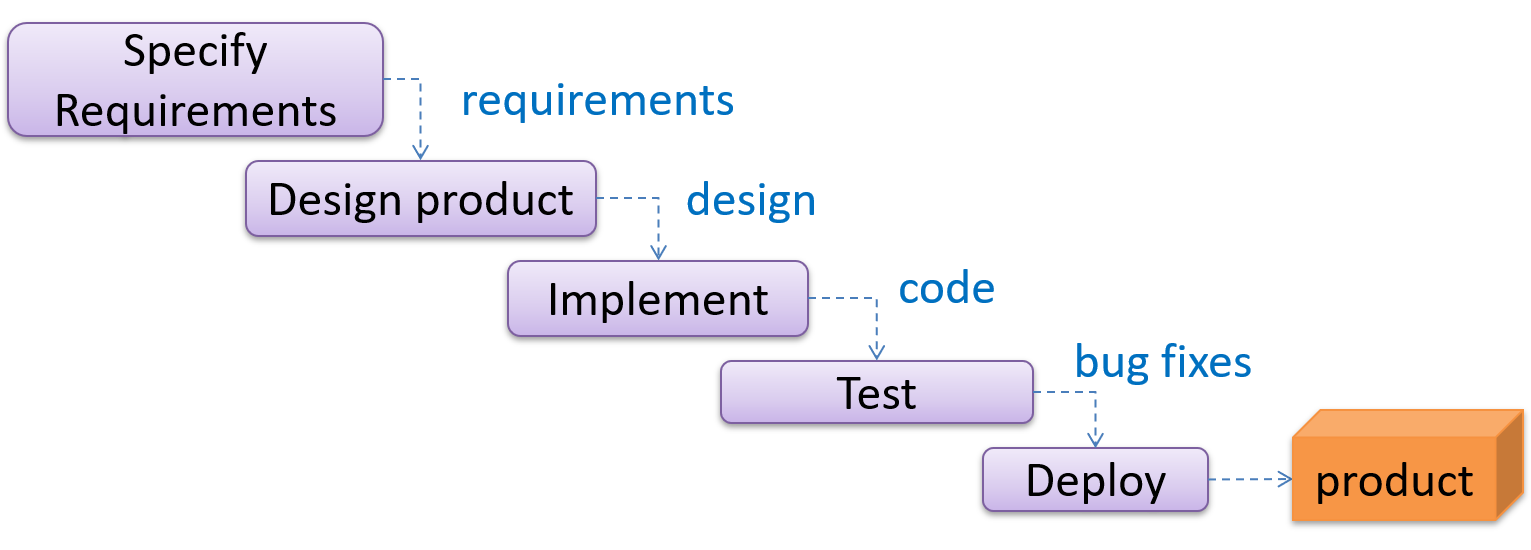
When one stage of the process is completed, it produces some to be used in the next stage. For example, the requirements stage produces a comprehensive list of requirements to be used in the design stage.
A strict sequential model project moves only in the forward direction i.e., each stage is completed before starting the next. For example, once the requirements stage is over, there is no provision for revising the requirements later. In practice the model is often relaxed to let a stage send work back to the one before it, although doing so means redoing work that was already treated as finished.
This model can work well for a project that solves a well-understood problem, in which case the requirements can remain stable and the effort can be estimated accurately. Furthermore, as each stage has a well-defined outcome, progress is easy to track: it is visible from which stage the project is in. Progress within a long stage, which is where an overrun usually builds up, stays much harder to see.
However, real-world projects often tackle problems that are not well-understood at the beginning, which makes those projects unsuitable for this model. For example, target users of a software product may not be able to state their requirements accurately at the start of the project if they have not used a similar product before.
A second weakness is that feedback arrives late. Each stage's output is checked mainly by the stage that follows it, so integration and contact with real users come near the end. A mistake made while gathering requirements or designing therefore tends to surface at the point where going back to completed work costs the most.
The iterative model advocates producing the software by going through several iterations. Each iteration could go through all the stages of the SDLC, from requirements gathering to deployment.
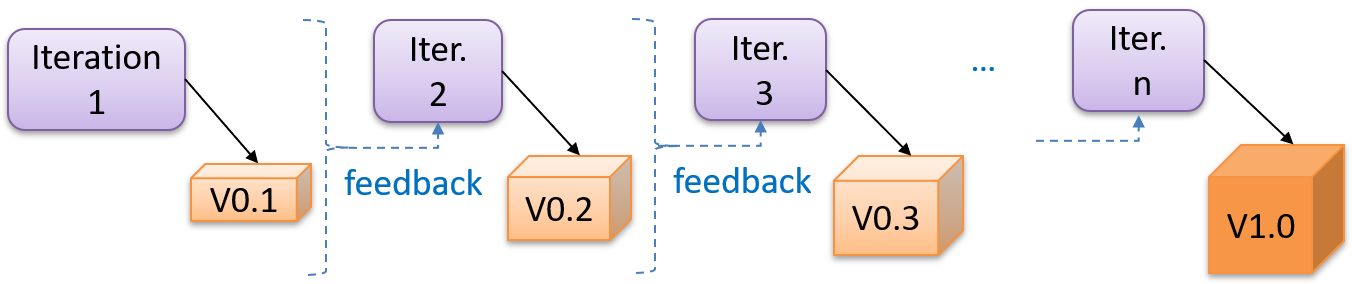
Each iteration produces a new version of the product, building upon the previous version. Feedback from each iteration is factored into the subsequent iterations. For example, if an implementation task took longer than expected, the effort estimate for similar tasks in future iterations can be adjusted. Similarly, if a feature introduced in the current iteration was not well-received by target users, it can be removed or tweaked in the next iteration.
The two models divide a project along different lines.
- A sequential project is divided by activity: a stage is 'requirements' or 'testing', and it ends when that activity is finished for the whole product.
- An iterative project is divided into bounded cycles instead: an iteration runs through several activities and ends in a result the team can learn from.
The iterative model can use a breadth-first or depth-first approach.
- In the breadth-first approach, an iteration evolves all major components and all functionality areas in parallel, producing a working product at the end of each iteration i.e., most features and most are updated in every iteration.
- In the depth-first approach, an iteration focuses on fleshing out only some components or some functionality area. Accordingly, early depth-first iterations might not produce a working product.
Iterating and incrementing are two different things, and most projects do both. To iterate is to rework something that already exists, in the light of feedback; to increment is to add to it. That is why the two are usually named together, as an iterative and incremental approach.
What an iteration delivers is called an increment: a usable improvement or addition to the product, not merely a new version of the code.
Ideally, an iteration should produce not only progress but also new knowledge. Before starting one, decide what would show it succeeded -- a condition the result must satisfy, a test that must pass, or a demonstration to a target user -- and what decision the answer will drive.
Example An iteration can add a new feature while helping the team estimate the effort for similar future features or assess the advantages and disadvantages of the approach used to implement it.
Example Taking a Minesweeper game as an example:
- breadth-first iterations will deliver a fully playable version early. These early versions may have primitive functionality, e.g. a rudimentary text-based UI, fixed board size, limited minefield layouts. This functionality (and the corresponding components) will then be improved in later iterations.
- an early depth-first iteration could deliver the full user interface (UI) but with no game logic at all. Alternatively, an early iteration could focus on just the logic for generating initial layouts of the minefield. Neither is a playable version of the game, but both can collect early feedback -- on the UI in the first case, on the minefield layouts in the second. That feedback then guides later iterations.
A project can be done as a mixture of breadth-first and depth-first iterations i.e., an iteration can contain some breadth-first work as well as some depth-first work, or some iterations can be breadth-first while others are depth-first.
Whichever shape the iterations take, an early one is a chance to find out you were wrong while changing course is still cheap. That makes the assumptions whose failure would cost the most -- an unproven technology, an unfamiliar user need, a performance target nobody has hit yet -- worth putting into an early iteration rather than a late one.
The following description was adapted from the XP home page, emphasis added:
Extreme Programming (XP) stresses customer satisfaction. Instead of delivering everything you could possibly want on some date far in the future, this process delivers the software you need as you need it.
XP aims to empower developers to confidently respond to changing customer requirements, even late in the lifecycle.
XP emphasizes teamwork. Managers, customers, and developers are all equal partners in a collaborative team. The team self-organizes around the problem to solve it as efficiently as possible.
XP aims to improve a software project in five essential ways: communication, simplicity, feedback, respect, and courage. Extreme Programmers constantly communicate with their customers and fellow programmers. They keep their design simple and clean. They get feedback by testing their software starting on day one. With this foundation, Extreme Programmers are able to courageously respond to changing requirements and technology.
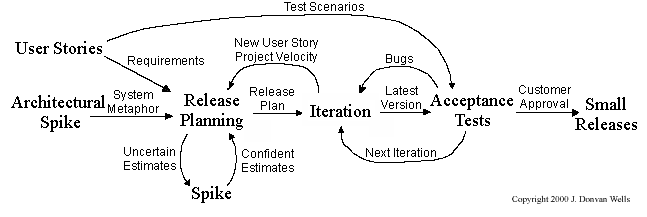
What makes XP 'extreme' is not the practices it uses but how often it uses them. Each one was already considered good; XP pushes each to the point where it happens continuously rather than in a scheduled phase:
- releases are small and frequent, rather than saved up for a milestone;
- code is integrated continuously, rather than merged near the end (continuous integration);
- tests are written before the code they test, rather than after (test-driven development);
- the design is refactored constantly, rather than in a cleanup phase;
- two programmers write the code together at one keyboard, so it is reviewed as it is written rather than in a scheduled review (pair programming).
Scrum is a lightweight agile framework rather than a complete process. It fixes a small set of roles, events, and artifacts, and leaves the team to fill in the rest with practices of its own choosing. The description below follows the Scrum Guide.
A Scrum team has three accountabilities:
- The Product Owner, who represents the stakeholders and decides what the product needs next
- The Scrum Master, who is accountable for the team using Scrum well
- The Developers, a cross-functional group who do the analysis, design, implementation, and testing
A Scrum project is divided into short iterations called Sprints. Sprints are time-boxed (i.e., restricted to a fixed duration) at one month or less, and every Sprint in a project has the same length. One to four weeks is the common choice.
A Sprint contains all the work done in it, together with all its events. It opens with Sprint Planning, where the team selects the work and agrees on a Sprint Goal, and the Developers coordinate daily as the work proceeds. It ends with two distinct meetings: a Sprint Review, where the team and stakeholders inspect the Increment and decide what the product needs next, and a Sprint Retrospective, where the team inspects how it worked and chooses improvements. The next Sprint begins immediately after.
During each Sprint, the team creates a potentially deliverable Increment (for example, working and tested software). The work comes from the Product Backlog, a prioritized set of high-level requirements for the product as a whole. The items selected for the current Sprint form the Sprint Backlog.
Within a Sprint the Sprint Goal stays fixed, but the plan for reaching it does not. The team updates the Sprint Backlog as it learns more, and can renegotiate the scope with the Product Owner as long as the Sprint Goal survives. The Sprint must end on time; work that is not completed returns to the Product Backlog.
Scrum enables self-organizing teams, which rely on frequent and direct communication among all team members and disciplines rather than on documents handed from one to the next.
Scrum assumes that customers will change their minds about what they want (often called requirements churn) and that unforeseen problems cannot be planned for in advance. It therefore takes an empirical approach: instead of trying to define the problem fully up front, it maximizes the team's ability to deliver quickly and respond to requirements as they emerge.
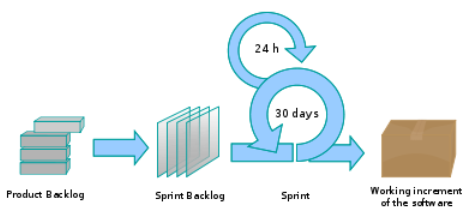
The Daily Scrum is a short daily meeting in which the Developers synchronize their plans, surface whatever is blocking them, and decide what needs to be taken up separately. It is not a problem-solving meeting.
Example A common way to run it is for each member to say what they did since the previous Daily Scrum, what they plan to do next, and what is in their way.
The unified process was developed by the Three Amigos -- Ivar Jacobson, Grady Booch, and James Rumbaugh (the creators of UML).
The unified process consists of four phases: inception, elaboration, construction, and transition. The main purpose of each phase can be summarized as follows:
| Phase | Activities | Typical Artifacts |
|---|---|---|
| Inception |
|
|
| Elaboration |
|
|
| Construction |
|
|
| Transition |
|
|
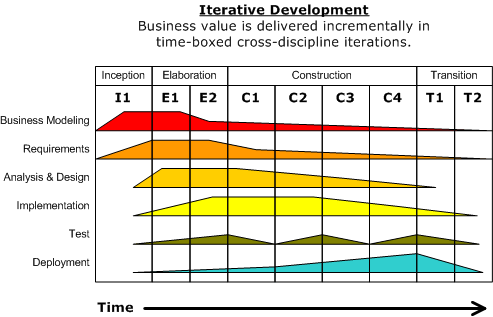
The diagram above visualizes a project done using the unified process (source: Wikipedia). The four phases run from left to right and each vertical column is a single iteration; the shading shows how much effort a given workflow, such as 'Requirements' or 'Analysis & Design', takes up in that iteration.
Phases and iterations are two different things, which is why a project can be phased and iterative at the same time: a phase says where the project is in its overall arc, while an iteration is one pass of work through several workflows. A phase is also not a development stage: each phase contains work from several stages.
The unified process is a customizable framework rather than a single fixed process. For example, the number of iterations in each phase, the definition of workflows, and the intensity of a given workflow in a given iteration can be adjusted according to the nature of the project. Therefore, the diagram above simply records a particular application of the UP rather than prescribes how the UP is to be applied. However, this record can be refined and reused for similar future projects.
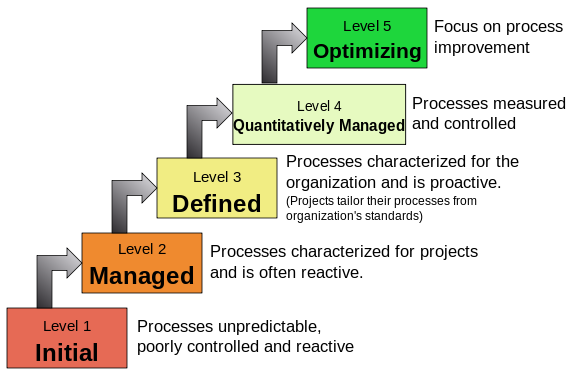
A team's process is itself something that can be assessed and deliberately improved, rather than chosen once and left alone. Frameworks exist for doing that assessment, and they matter most where a customer wants evidence that a supplier can be relied on before awarding it work.
CMMI (Capability Maturity Model Integration), defined by the Software Engineering Institute at Carnegie Mellon University, is the best known of them. It defines five maturity levels, ranging from ad hoc to continuously improving, and criteria for determining which one an organization's process has reached.